Accessibility · BFSG
Accessible websites: what the BFSG actually requires
Germany's Accessibility Strengthening Act (BFSG) has applied since 28 June 2025. Many businesses are not covered at all — yet are being pushed into retrofits with scare emails. Here is how it really looks.
5.0 on GoogleReal client projects from the region
The BFSG implements an EU directive and obliges certain companies to make their digital offerings accessible. The catch in the current excitement: the obligation covers far from every website — and at the same time, accessibility pays off even where it is not required. Both belong in the same sentence, otherwise a law turns into a sales trick. We will tell you free of charge which group your website falls into.
Check first, talk later
Whether the BFSG covers you at all is something we clarify free of charge — before anyone discusses rebuilds.
Built in, not bolted on
Every website we build is accessible from the start, at no surcharge. Retrofitting elsewhere is what costs.
No jargon
WCAG, EN 301 549, BFSGV — we translate the standards into a handful of concrete points your site either meets or doesn't.
Technical demo
See it, don't read about it.
Our technical demo runs in the browser and shows what modern web technology can do today — hand-built, with the same technology we use in client projects. Not a client project, not a template.
Who the BFSG covers — and who it doesn't
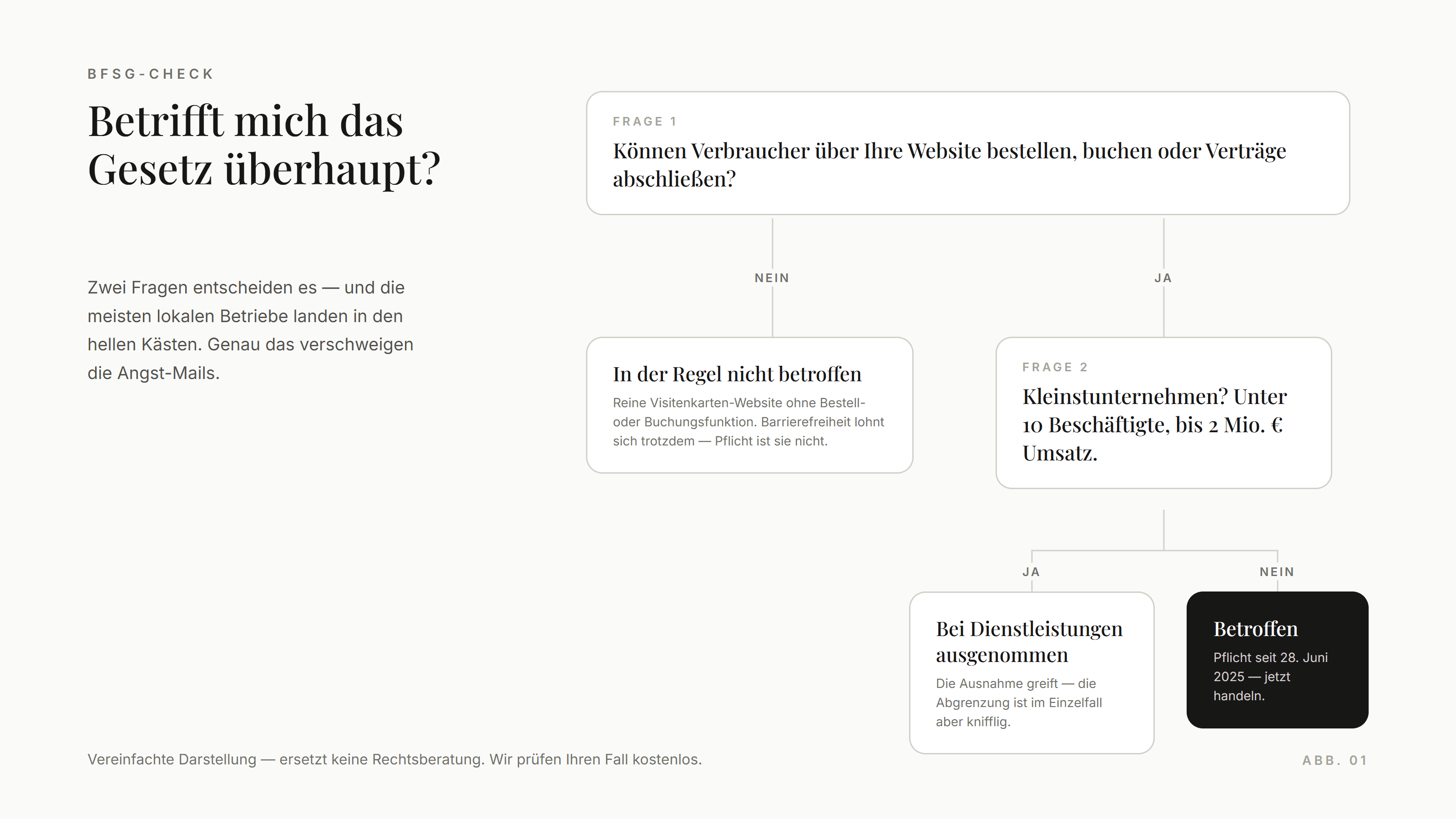
Covered are websites and apps through which consumers can conclude contracts or book: online shops, appointment booking, reservations, order forms. Pure brochure websites without such functions are generally not covered.
The most important exemption: micro-enterprises offering services — fewer than ten employees and at most two million euros in annual turnover — are exempt for their services. A large share of tradespeople, practices and local service providers simply do not have to.
Still important: those who are covered and do nothing risk warnings and fines. And the line can be tricky in individual cases — which is exactly what our free check is for. It does not replace legal advice, but it tells you honestly whether to treat the topic as relaxed or serious.
What makes a website accessible
Accessibility is not magic but craft to a standard — the WCAG criteria, which the BFSG references via the European norm EN 301 549. Concretely that means, among other things: sufficient colour contrast, full keyboard operability, alternative text for images, a clean heading structure, forms with real labels and error messages people understand. Plus respect for system settings such as reduced motion.
Most of it is invisible on a good website — you only notice it when it is missing. That is why retrofitting costs more than building right: think accessibility in from the start and you barely pay for it at all.
Why it pays off even without the obligation
Roughly one in ten people in Germany lives with a disability; add older users, people with poor eyesight, and everyone who occasionally operates a website by keyboard or screen reader. An accessible site excludes nobody — that is reach your competitors leave on the table.
And: much of what accessibility demands, Google demands too. Clean structure, alternative texts, fast and clearly operable pages feed straight into visibility. With us both are the same motion: every new website from €2,500 fixed price is built accessible, at no surcharge. No VAT is shown in accordance with § 19 UStG (small business); all amounts are final.
Free tool
How good is your website really?
The free website check shows in 30 seconds where your site stands technically: loading time, encryption, Google basics, imprint and more. No sign-up, no email — instant result.
What clients say
Unabridged reviews from our Google Business Profile, in the original German.
Ich bin absolut begeistert von der Arbeit von Paul! Er hat meine Webseite nicht nur technisch einwandfrei eingerichtet, sondern auch ein tolles Gespür für Design und Benutzerfreundlichkeit bewiesen. Die Zusammenarbeit war von Anfang an unkompliziert, professionell und sehr angenehm. Paul ist jederzeit auf meine Wünsche eingegangen, hat alles verständlich erklärt und eigene kreative Ideen eingebracht, die das Ergebnis deutlich verbessert haben. Besonders beeindruckt hat mich seine schnelle Umsetzung und seine Zuverlässigkeit. Ich kann Paul uneingeschränkt weiterempfehlen – wer eine moderne, funktionale und ansprechende Webseite möchte, ist bei ihm genau richtig!
Angelika WagnerGoogle review, 5 out of 5 stars Sehr professionelles Unternehmen mit modernem, ansprechendem erstellten Webdesign. Die Beratung war unkompliziert, freundlich und kompetent. Wünsche wurden schnell und zuverlässig umgesetzt. Würde es jedem weiterempfehlen.
DanielGoogle review, 5 out of 5 stars
Common questions
Does the BFSG apply to my website?
Only if consumers can conclude contracts or book through it — such as a shop, appointment booking or order form — and you are not an exempt micro-enterprise (under ten employees, up to two million euros turnover, for services). A pure brochure website is generally not covered. We check your specific case free of charge.
I run a micro-enterprise — can I ignore the topic?
The legal obligation usually does not apply to your services. We still would not ignore it: accessibility brings reach and better Google visibility — and if your website is being rebuilt anyway, it costs nothing extra.
What happens if I am covered and do nothing?
Market surveillance can order measures up to prohibition, fines are possible, and competitors or associations can issue warnings. Realistically it usually starts with a demand to fix things — it gets expensive when that is sat out.
What does it cost to make an existing website accessible?
That depends on the foundation. Technically clean sites often need manageable adjustments; with old template sites, a rebuild from €2,500 is frequently cheaper than patching. After the free check we tell you which case you are. No VAT is shown in accordance with § 19 UStG (small business); all amounts are final.
Are your websites accessible by default?
Yes. Contrast, keyboard operation, alternative texts, structure, forms, reduced motion — that is our standard, not an add-on package. Our own website follows the same rules.
Is an accessibility overlay or plugin enough?
No. Overlay tools sit on top of the page instead of fixing it and are considered inadequate by experts and affected users alike — sometimes they make things worse. Accessibility is built into a site, not layered over it.
More services in the region
Not sure whether your website is covered?
Send us your website — we will tell you free of charge and honestly whether the BFSG applies to you and, if so, what actually needs doing.
Contact
Where do you stand on Google?
Tell us briefly what it's about — we'll look at your situation and usually get back to you within 24 hours. Free and without obligation.